
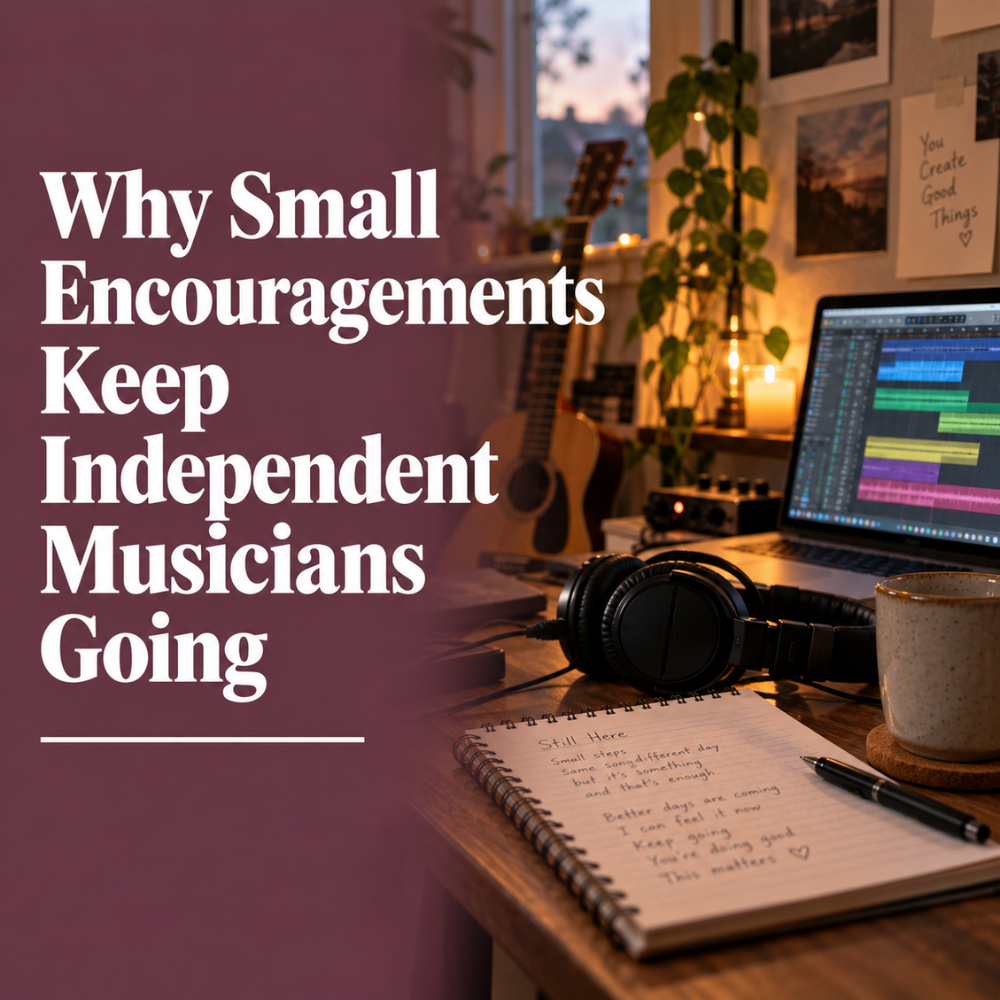
One of the strange things about making music independently is that the moments which keep you going are often very small. Not the dramatic moments, not huge streaming numbers, sold-out rooms or glowing reviews. Most amateur and independent musicians are not living in that world anyway. What tends to matter more are the quieter things: a message from someone who liked a song, a person who stayed behind after a gig to say a lyric meant something to them, a CD sale, a new follower, a comment from someone you have never met, or simply noticing that somebody in a distant city has been listening.
Those little signs matter because most of the work happens without an audience. Writing a song is private. Recording it at home is private. Spending hours in Cubase trying to get a part right, re-recording a vocal, changing an arrangement, listening back, doubting yourself and then carrying on are all things that happen long before anybody else is involved. By the time a song is released, you may already have lived with it for weeks or months.
Then you put it into the world and wait, and that is where encouragement becomes important.
Independent music can be a very quiet business. You can put a great deal of effort into something and receive almost no visible response. A song may be streamed without anyone commenting, a post may be seen without anyone reacting, and a live performance may go well but everyone simply goes home afterwards. That silence can make you wonder whether any of it is connecting.
Then one person says they liked the song. Someone tells you a line stayed with them. Someone says they listened to your album in the car, added a track to a playlist, or came across your music and wanted to let you know they enjoyed it. These are small remarks, but they can carry a surprising amount of weight.
For a musician who is not chasing fame, that kind of response is often closer to the real reason for making music in the first place. You are not necessarily looking for mass attention; you are looking for connection. You want to know that something which began in your head has reached someone else, and that can be enough to make the effort feel worthwhile.
This is one of the reasons live performance matters so much too. At Songwriter Evening, the audience may not be enormous, but that is not the point. When people are actually listening, when they respond to an original song, when someone comes up afterwards and mentions a lyric or asks about another track, the encouragement feels immediate and real. You can see the connection rather than infer it from a number.
Streaming is different. It gives you data, but it does not always give you meaning. You may see that a song has been played in Nuuk, Sydney, Melbourne or somewhere else and enjoy the fact that it has travelled, but you rarely know who listened or what they thought. A message fills in that gap because it turns a stream into a person, and that matters more than it might seem.
The same is true of physical music. If someone buys a CD or vinyl record, that feels different from an anonymous stream. They have made a small decision to own the music. They have decided it is worth having, not just hearing for a few minutes, and for an independent musician that is encouraging in a very direct way.
The danger, of course, is becoming too dependent on feedback. If you start needing constant reassurance, music can become emotionally exhausting. Not every song will get a response, not every post will work, and not every performance will produce a conversation afterwards. Silence does not always mean failure. Sometimes people listen quietly, enjoy something and never tell you, or a song may matter to someone in a way you will never know.
That is worth remembering, but when encouragement does come I think it should be valued properly.
People often underestimate how much courage there can be in sharing original work. Writing a song is one thing; releasing it, performing it and attaching your name to it is another. You are giving people the opportunity to like it, ignore it, misunderstand it or dislike it, and that vulnerability is part of the process.
So when someone responds positively, it does more than flatter the ego. It confirms that the bridge between writer and listener has actually worked. The song got across, and for musicians who are not trying to build a career, that can be one of the most important measures of success.
It may also be why seemingly tiny moments stay in the memory. You may forget a lot of streaming figures, but remember someone telling you a particular song meant something. You may forget how many people were in a room, but remember one conversation afterwards. Those moments become part of the reason to carry on.
Independent musicians need that because there are plenty of reasons not to. Recording takes time. Equipment costs money. Software can be frustrating. Mixing and mastering require expertise. Promotion can feel awkward. Social media can be exhausting. Streaming income is minimal and live opportunities can be limited.
If the only reward were numbers, many people would probably stop. But numbers are not the only reward.
The reward can be hearing the finished song sound better than it did in your head. It can be playing it live and feeling the room stay with you. It can be a stranger somewhere pressing play, a friend asking when the next song is coming, somebody buying a CD, or one message arriving at exactly the right time. Those things are small, but they are not insignificant.
In fact, for independent musicians, they may be the whole point.
There is something deeply encouraging about knowing that your music has reached even one person in the way you hoped it might. It reminds you that the work does not simply disappear when you release it. It goes somewhere, and sometimes, if you are lucky, somebody lets you know.
That can be enough to make you open Cubase again, pick up the guitar, start another lyric and begin the whole process all over.
Small encouragements do not make you famous, but they can do something more useful: they keep you making music.