
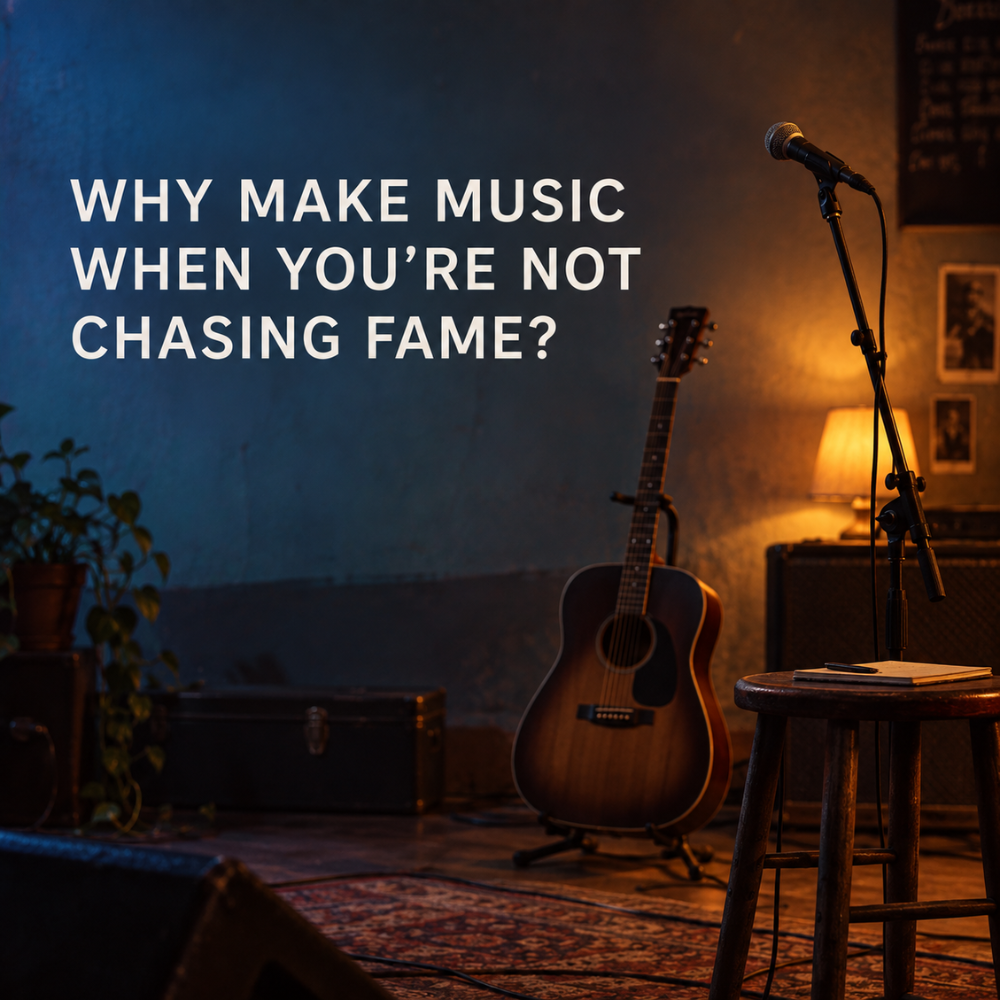
There is a question that sits behind a lot of amateur music-making, even when nobody asks it directly.
Why are you doing this?
It is not an unreasonable question. If you are not chasing fame, not expecting to make a living from it, not waiting for a record company to appear at the door with a contract and a flattering amount of enthusiasm, then the whole thing can look slightly irrational from the outside. Writing songs takes time. Recording them takes longer. Releasing them involves effort, expense, self-promotion, uncertainty and a surprising amount of admin for something that began with a few chords and a feeling.
And yet, people still do it. I still do it.
That tells me something important. Music is not only made by people who expect a career from it. It is also made by people who need a way to express themselves. For some of us, writing songs is not a route to fame and fortune. It is a way of making sense of things. A way of turning thoughts, memories, regrets, hopes, humour, frustration and small observations into something that can be sung.
That may sound modest, but it does not feel modest when you are doing it.
A song can begin in a very ordinary way. A phrase comes to mind. A chord change catches your attention. A memory refuses to stay quiet. Something happens in life that does not want to become a diary entry, but might become a verse. You pick up a guitar, sit at a keyboard, open a notebook, hum something into your phone, or simply carry the idea around until it starts to take shape.
At that point, you are not thinking about fame. You are thinking about whether the song is true. Not necessarily true in a literal, documentary sense, but true in the way songs need to be. Does it feel honest? Does it say what you meant? Does the melody carry the feeling? Does the chorus open the door a little wider? Does the line you wrote at midnight still make sense in the morning?
That is the real work.
Of course, the modern world does not always make it easy to keep that in focus. Once a song is written, everything around it starts demanding attention. You have to record it, arrange it, mix it, master it, upload it, describe it, promote it, post about it and then persuade people to listen without sounding like a man who has trapped them in a lift. Even if you are not chasing fame, you still find yourself doing many of the things that people chasing fame have to do.
That is one of the strange pressures on independent musicians today. You may simply want to express yourself through songs, but the moment you release music, you are pulled into the machinery of platforms, links, images, algorithms and statistics. Suddenly the private act of writing has to survive the public business of being noticed.
It can be uncomfortable.
Many amateur musicians are not natural self-promoters. We are happier working on a lyric than crafting a social media caption. We can spend hours getting a vocal right, but feel faintly embarrassed asking people to press play. There is a tension between wanting the song to be heard and not wanting to become tiresome. You believe in the music, but you also know that everyone else is busy, distracted and quite possibly already being asked to listen to seventeen other things before lunchtime.
So why bother?
I think the answer is that the song itself matters before anyone else hears it. The act of making it has value. Finishing it has value. Recording it has value. Playing it live has value. Even if the audience is small, even if the streams are modest, even if the world does not rearrange itself in response, the song has still done something. It has taken something internal and given it shape.
That is not nothing.
For me, making music has never really been about chasing fame. That does not mean I do not want people to listen. Of course I do. Every songwriter wants listeners. A song kept permanently to yourself is like a letter never posted. But wanting listeners is not the same as craving celebrity. Wanting a song to connect with someone is not the same as wanting to be famous.
There is a big difference between wanting attention and wanting connection.
Connection can happen quietly. It might be someone listening to a track online. It might be a person at a live event who comes up afterwards and says they liked a line. It might be someone buying a CD, playing an album in the car, or hearing a song at the right moment in their own life. These are not huge public victories, but they are real ones.
For independent musicians, especially those of us who are not measuring success in fame or fortune, those moments matter enormously.
There is also something grounding about accepting the scale of what you are doing. Not every song has to change the world. Not every album has to be a career move. Not every live performance has to be a stepping stone to something larger. Sometimes the point is the song, the room, the recording, the feeling, the small exchange between performer and listener.
That can be enough.
In fact, there is a freedom in not chasing fame. It allows you to make the music you actually want to make. You do not have to follow trends. You do not have to pretend to be younger, cooler, louder, edgier or more marketable than you are. You can write from where you really stand. You can make songs that reflect your own life rather than a version of yourself designed to please an imaginary audience.
That freedom is valuable.
It does not remove pressure entirely. There is still the pressure to finish, to improve, to promote, to be heard. There is still the frustration of putting work into the world and wondering whether anyone has noticed. There is still the occasional dark comedy of checking streaming numbers and trying to interpret them like ancient runes. But underneath all that, there is a simpler reason to keep going.
The songs keep arriving.
That is probably the most honest answer. You make music because something in you keeps wanting to make music. Not because it is sensible. Not because it is lucrative. Not because it guarantees applause. You do it because writing a song gives shape to something that would otherwise remain unspoken.
That is why recorded music matters. It captures the song and gives it a life beyond the moment of writing. It allows something made in private to travel. It turns a passing idea into something that can be returned to, shared, released, collected, streamed, played on CD, or pressed onto vinyl.
That is also why live music matters. A recording lets the song travel, but a live performance lets it breathe in front of people. When you play an original song to a room that is genuinely listening, the song becomes immediate again. It is no longer a file, a link or a track listing. It is a voice, an instrument and a moment.
For musicians who are not chasing fame, that may be the heart of it. The point is not to conquer the world. The point is to keep creating honest songs and give them a chance to reach someone.
There is dignity in that.
Amateur music is sometimes treated as lesser music, as if doing something for love rather than money somehow makes it less serious. I think the opposite can be true. The word amateur comes with no guarantee of quality, of course, but it does suggest something important. It suggests love. It suggests commitment without certainty of reward. It suggests doing the work because the work itself matters.
That feels like a good enough reason.
So why make music when you are not chasing fame?
Because songs still need somewhere to go. Because expression matters. Because a small audience can still be a real audience. Because a single listener can still make the effort worthwhile. Because recording and performing original songs keeps something alive that statistics cannot measure.
And because, in the end, some of us simply do not know how to stop.
You can listen to my music on Spotify, Apple Music, Amazon and the usual streaming platforms, or explore more of my songs, albums and stories here on my website.