
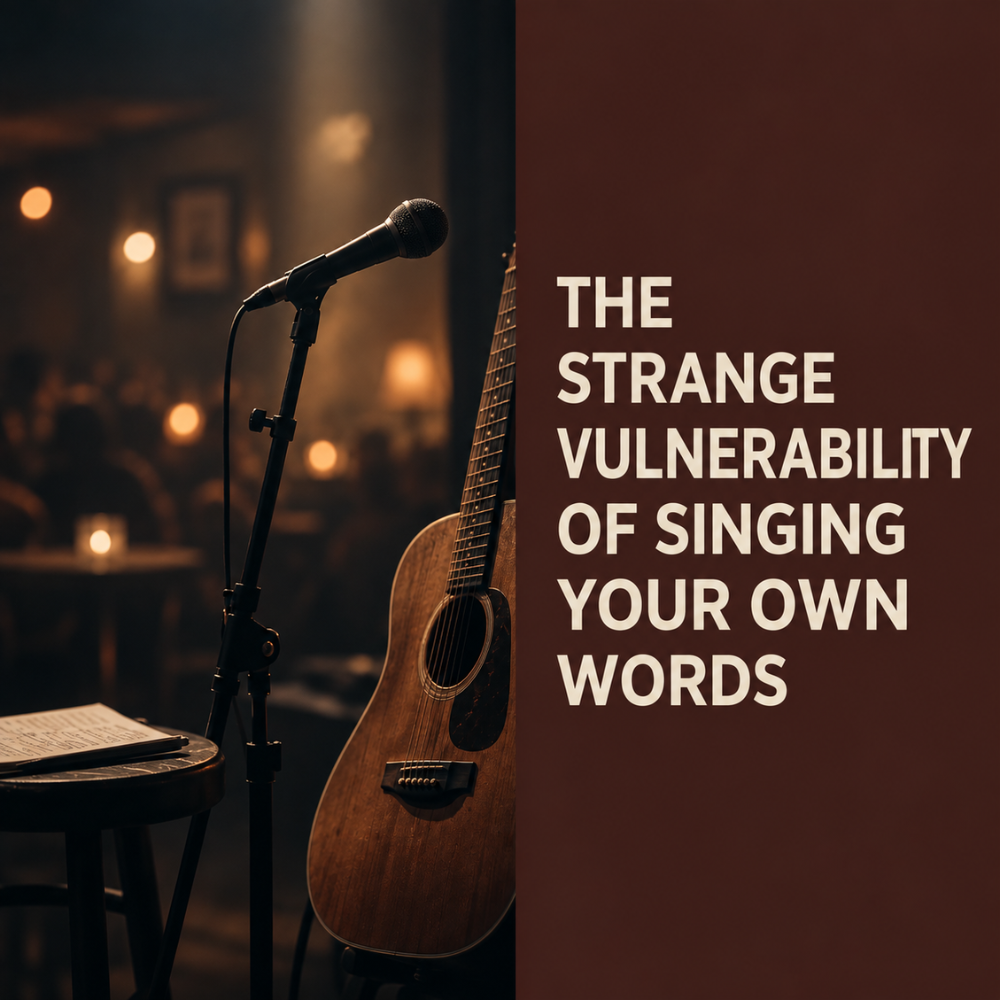
There is a big difference between singing a song and singing your song.
On the surface, the mechanics may be identical. You stand there, take a breath, find the first note and hope your hands remember what they are supposed to be doing. But emotionally, they are not the same thing at all. When you sing someone else’s song, you are borrowing their words. When you sing your own, there is nowhere to hide.
That can feel surprisingly exposed.
A cover version comes with a certain amount of protection. The song already exists in the world. It has been heard before, probably many times. The audience may know it, like it, even sing along with it. If the lyric is dramatic, personal, angry, tender or embarrassing, those words belong to somebody else. You are interpreting them rather than admitting to them.
Original songs are different.
When you stand up and sing something you wrote yourself, you are effectively saying, “I thought this. I felt this. I noticed this. I decided this was worth turning into a song.”
That is a much bigger statement than it first appears.
Songwriting is often private. The first version of a song may exist only in your head, on a scrap of paper, in a phone recording or in a room at home with nobody listening. At that stage, you can be completely honest because there is no audience. You can write the line because it feels right, not because you have considered how it will sound when ten, twenty or fifty people are sitting in front of you.
Then one day you have to sing it to them.
That is the vulnerable bit.
I think many songwriters know the strange moment when a lyric that felt perfectly natural while writing suddenly feels much more revealing when spoken aloud in front of people. It may not even be particularly personal on paper, but once it is attached to your own voice and your own face, it becomes yours in a very public way.
You become aware that people are listening not just to how you sing, but to what you are saying.
That changes everything.
It can make you second-guess lines you were perfectly happy with before. You start wondering whether a lyric sounds too sentimental, too direct, too personal, too obvious, too clever, not clever enough, or simply ridiculous when delivered with a guitar in your hands and several pairs of eyes looking back at you.
This is one of the reasons performing original material can feel much riskier than playing familiar songs.
The audience has nothing to compare it with. They do not know where the chorus is going. They do not know what mood to expect. They have not already decided they like the song. You are asking them to trust you for three or four minutes and follow something they have never heard before.
That is quite a lot to ask.
At Songwriter Evening, this is one of the things I enjoy most about hearing people perform. Every original song carries a little bit of that risk. It does not matter whether the song is funny, sad, political, personal, observational or completely absurd. The person performing it has decided to put something of themselves into the room.
That deserves respect.
It also creates a different kind of atmosphere from an evening built around covers. With original music, nobody knows what is coming next. There is a sense of discovery. The audience has to listen properly because there is no familiar chorus waiting to rescue them.
For the songwriter, that is both exciting and unnerving.
I have felt that myself.
There are songs that feel easy to sing at home and much harder in front of people. Sometimes it is because of the lyric. Sometimes it is because the subject matters more than you realised. Sometimes it is simply because you suddenly become aware that the song says more about you than you intended.
That is not necessarily a bad thing.
In fact, I think that is often where the value is.
A song that exposes something real tends to connect more strongly. It may not connect with everyone, but that is not the point. If one person recognises something in it, then the vulnerability has done its job. The song has moved from being a private thought to a shared experience.
That is one of the most powerful things about songwriting.
You can take something very personal and make it strangely universal. A memory becomes a verse. A regret becomes a chorus. A joke becomes a lyric. A feeling that seemed completely individual can suddenly make sense to someone else.
That is the magic, but it only works if you are willing to risk being heard.
There is also another kind of vulnerability that has nothing to do with confession. Sometimes the song itself simply matters to you. You may have spent weeks writing it, recording it and shaping it. You may be proud of it. You may think it says exactly what you wanted to say.
Then you play it live and wait.
That pause after the final chord can feel very long.
You are not only waiting for applause. You are waiting to find out whether the song landed at all.
With a well-known cover, the reaction often comes built in. With an original song, nothing is guaranteed. People might love it. They might be politely attentive. They might be moved. They might be confused. They might simply move on to the next thing.
That uncertainty is part of the deal.
For independent musicians who are not chasing fame, this kind of live response can matter more than statistics. A streaming number tells you someone pressed play. A room tells you whether people stayed with you. You can feel when a lyric lands. You can sense when a room becomes quiet. You can hear the difference between polite applause and genuine engagement.
Those moments stay with you.
They also teach you things about your own songs.
Sometimes you discover that the line you were worried about is the one people remember. Sometimes a song you thought was too personal turns out to be the one that connects most strongly. Sometimes you realise the audience is hearing something in the song that you did not consciously put there.
That is part of the fascination.
Once a song leaves you, it stops belonging entirely to you. People interpret it through their own lives. Your memory becomes their memory. Your sadness becomes their sadness. Your humour works differently for them. That process begins the moment you sing the song to somebody else.
Which is why the vulnerability is worth it.
If you protected yourself completely, the songs would stay safe but probably less interesting. You could sand off every personal edge, avoid every awkward truth and make sure nothing revealed too much.
But then what would be left?
The songs that matter usually carry some risk.
Not necessarily in a dramatic way. Vulnerability does not always mean confession. It can simply mean sincerity. It means standing behind the words. It means singing something because you believe it, or because it amused you, or because it bothered you enough to write it down.
That is enough.
I think this is why original live music matters so much to me. When someone performs their own song, you are hearing something that has not passed through somebody else first. The words belong to the person singing them. The choices are theirs. The little flaws, hesitations and unexpected moments are theirs too.
That makes the performance human. And perhaps that is what audiences respond to. Not perfection, presence.
The strange thing is that the more vulnerable the song feels to perform, the more likely it is to mean something if it connects. That does not make the nerves disappear, but it gives them a purpose.
So yes, singing your own words can feel exposed. You are putting a small piece of yourself into the room and hoping people handle it kindly. But if nobody ever heard the words, there would not be much point in writing them in the first place.
That is the risk.
And, for songwriters, it is also the reward.