
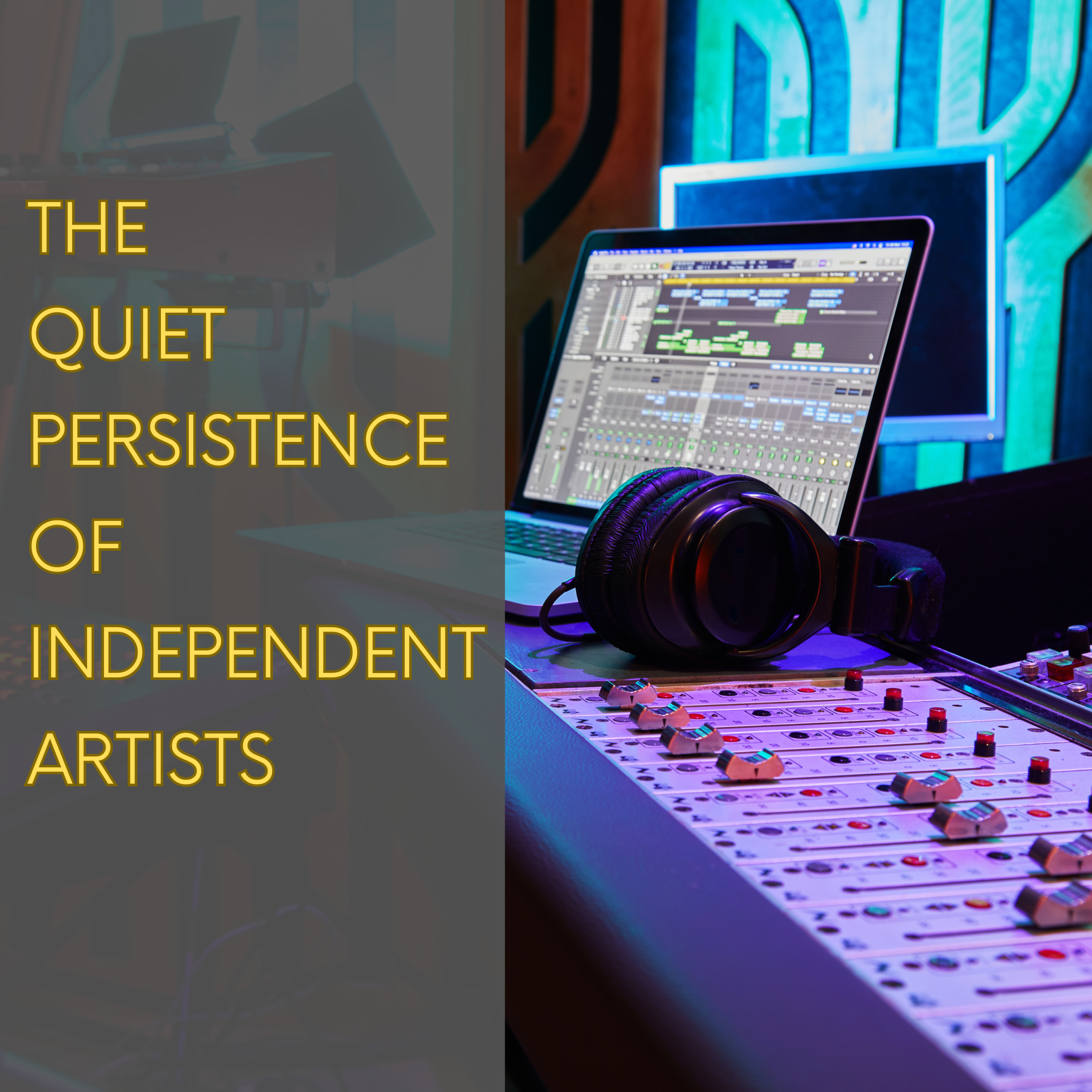
There is a strange kind of faith involved in continuing to make music when very little evidence suggests that you should.
Not religious faith, necessarily. Not even confidence. Confidence would suggest that you know where it is all going, that you can see some kind of reward waiting in the distance. Most independent musicians do not have that luxury. They are not working towards a guaranteed audience, a record deal, a breakthrough moment, or even a reliable sense that the next thing they release will be heard by more than a handful of people.
And yet they keep going.
That is one of the least discussed aspects of independent music. Not the glamour of it, because there often is not much glamour. Not the dream of being discovered, because for many musicians that dream faded years ago. Not even the romance of the struggling artist, because struggle is rarely romantic when you are the one trying to find time, money, energy, and belief for another song, another recording, another release.
What remains is persistence.
The quiet kind.
The kind that does not announce itself very loudly. The kind that happens in spare rooms, small studios, rehearsal spaces, kitchens, garages, laptops, notebooks, and hard drives. The kind that continues after the first burst of excitement has gone, after the easy encouragement has dried up, after the friends who once said “you should really do something with this” have moved on to other parts of life.
For independent artists, persistence is often not dramatic. It is not the grand cinematic image of someone refusing to give up against impossible odds. More often, it is simply returning to the song again after work. It is opening the project file even though you are tired. It is replacing a vocal line that has been annoying you for weeks. It is writing one more verse, trying one more mix, booking one more rehearsal, uploading one more track, knowing perfectly well that the world is unlikely to stop and take notice.
That may not sound heroic, but it is.
Because the hardest part of making music independently is not always the music itself. The hardest part is continuing when there is no momentum.
Momentum is powerful. When people are listening, responding, sharing, buying, commenting, and turning up, it becomes much easier to believe that the work matters. There is energy coming back towards you. Even a small amount of attention can make the whole thing feel more real. It gives shape to the effort. It confirms that the songs have travelled beyond the room where they were made.
But many independent musicians spend long periods without that feeling. They release something and the response is modest. Or almost invisible. A few kind words. A few likes. A handful of streams. Perhaps one or two people who genuinely connect with it. Then everything goes quiet again.
That silence can be difficult to live with.
It is not just about ego, although ego is always somewhere in the room. It is about trying to understand the value of the work when the outside world gives you very little to measure it by. If a song took months to write and record, but only a small number of people hear it, what does that mean? Was it worth doing? Was the time well spent? Should you do it again?
These questions do not always arrive dramatically. They creep in. They appear late at night when you are listening back to something you have made and wondering whether anyone else will ever care about it. They appear when you see other artists gaining attention and you are happy for them, but also quietly aware of your own stillness. They appear when another year passes and you are still explaining to people that yes, you are still making music.
Still.
That word can carry a surprising amount of weight.
There is a point at which “I make music” becomes less of a statement about ambition and more of a statement about identity. It is no longer only about what you hope might happen. It becomes part of how you understand yourself. You write, record, perform, release, or create because not doing so would feel stranger than continuing. The work may not provide a living, fame, or even consistent recognition, but it provides continuity. It connects the person you were with the person you are now.
That is why independent artists can keep going for years, sometimes decades, without obvious signs of success. They are not always chasing the same prize they chased at the beginning. At first, it may have been about being noticed. Later, it may become about finishing something properly. Then about documenting a period of life. Then about proving to yourself that you can still do it. Then about leaving a body of work behind. The reasons shift, but the need remains.
Persistence is not the absence of doubt. It is what happens after doubt has had its say.
Every independent musician knows doubt. Doubt about the songs, the voice, the playing, the production, the age you are, the audience you do not have, the money you have spent, the time you have used, the point of releasing anything into such a crowded world. Doubt can be very persuasive because it often sounds reasonable. It says: why bother? It says: who is waiting for this? It says: haven’t you done enough?
And sometimes the honest answer is that no one is waiting.
That can be hard to admit, but it can also be strangely freeing. If no one is waiting, then the work has to be justified by something deeper than expectation. You are no longer simply meeting demand. You are making something because it matters to you, because the idea keeps returning, because the song will not quite leave you alone, because there is still some part of you that wants to hear it finished.
This is where independent music becomes quietly powerful. It is not always powered by applause. It is powered by the stubborn belief that making something has value even when the market has not requested it. In a culture that constantly measures success through visibility, that is almost a rebellious act. To continue creating without a large audience is to resist the idea that attention is the only proof of worth.
Of course, attention matters. It would be dishonest to pretend otherwise. Most musicians want listeners. Songs are not usually made only to disappear into private storage. There is a reason people release music rather than simply keeping it on a hard drive. Sharing matters because connection matters. A single person hearing a song at the right time can mean more than a hundred passive streams. A small audience is still an audience. A quiet response is still a response.
But independent artists have to learn how to survive without depending entirely on that response. Otherwise, the emotional balance becomes impossible. If every release has to prove your worth, then every release becomes dangerous. If every small audience feels like failure, then the work becomes harder to continue. If every lack of recognition is taken as a verdict, then eventually you may stop before the work has had time to become what it could be.
That is why persistence has to be redefined.
For some artists, persistence means releasing music regularly. For others, it means returning after long gaps. For some, it means playing live whenever possible. For others, it means quietly building recordings over years. There is no single correct version of it. What matters is the act of continuing in a form that is still honest, still alive, and still connected to the reason you began.
There can be long gaps between releases. There can be years when life takes over, when family, work, money, health, or plain exhaustion push music into the background. That does not necessarily mean the story has ended. Sometimes persistence looks like output. Sometimes it looks like waiting. Sometimes it looks like keeping the equipment, keeping the notebooks, keeping the fragments, keeping the possibility open.
The myth of momentum tells us that everything should keep getting bigger. More listeners, better reviews, stronger numbers, larger rooms, higher production values, greater recognition. But many independent artists live a different reality. Things rise and fall. A project gets attention, then the next one does not. A song connects, then another disappears. An album feels important to you, but the world barely reacts. Progress is not always a straight line. Sometimes it is not even visible from the outside.
That does not mean nothing is happening.
A musician who keeps going is changing all the time. The writing becomes more honest. The arrangements become more instinctive. The voice becomes less concerned with imitation. The production choices become more deliberate. The themes deepen because life deepens. Even if the audience remains small, the artist is not standing still. The work carries the evidence of every previous attempt, including the ones nobody heard.
This is one of the great hidden rewards of persistence. You slowly become better at being yourself.
Not necessarily better in a way that the industry would know how to sell. Not necessarily more fashionable, more marketable, or more likely to break through. But better at recognising what belongs to you. Better at knowing when a song is false. Better at understanding what you are trying to say. Better at accepting that your work does not have to sound like anyone else’s idea of what success should be.
For amateur bands and solo musicians, this matters enormously. The world is full of systems that encourage comparison. Streaming numbers, social media metrics, followers, playlists, views, comments, shares. These things are not meaningless, but they are incomplete. They can tell you something about reach, but not everything about value. They can show activity, but not necessarily impact. They can measure attention, but not devotion.
The quiet persistence of independent artists exists beyond those numbers.
It exists in the person who is still writing songs after the band split up. In the singer who records vocals at home because studio time is too expensive. In the guitarist who keeps refining parts for a track only twenty people may ever hear. In the songwriter who returns to music after ten years away and discovers that the need is still there. In the older musician who no longer fits the usual story of youth, discovery, and breakthrough, but still has something to say.
There is dignity in that.
Not because every song is brilliant. Not because every release deserves a wider audience. Not because persistence automatically guarantees artistic greatness. It does not. Some songs fail. Some recordings fall short. Some ideas never quite work. But there is dignity in the continued attempt to make something truthful. There is dignity in carrying on without applause as your main fuel.
The independent artist often has to become their own source of permission. No one is going to arrive and formally declare that it is worth continuing. No one is going to certify that your work matters enough to justify the next album, the next gig, or the next song. At some point, you either grant yourself permission or you stop.
And many do stop. That should not be judged too harshly. Life is demanding. Music asks a lot and gives back unpredictably. Sometimes people move on because they need to. Sometimes the cost is too high. Sometimes the silence becomes too heavy. Continuing is not morally superior to stopping.
But when artists do continue, especially without much external reward, it is worth recognising what that means. It means they have found a reason that is not entirely dependent on applause. It means the work has become part of their way of making sense of life. It means that somewhere beneath the frustration, disappointment, and uncertainty, there is still a small but persistent belief that a song is worth finishing.
That belief may be quiet, but it is powerful.
It is easy to celebrate success when it is visible. It is harder to recognise the years before, between, and after those moments. The years when someone keeps writing without knowing whether it will lead anywhere. The years when a small catalogue slowly forms. The years when the work accumulates, not as a career strategy, but as evidence of a life spent paying attention.
Perhaps that is what persistence really creates: evidence.
Evidence that you were here. Evidence that you felt things deeply enough to turn them into songs. Evidence that you kept returning to the work even when the world was distracted. Evidence that creativity did not have to be profitable to be meaningful. Evidence that an independent artist’s life is not measured only by breakthrough moments, but by the long, quiet commitment to making something exist that would not have existed otherwise.
That may never look like success from the outside.
But from the inside, it can be everything.