
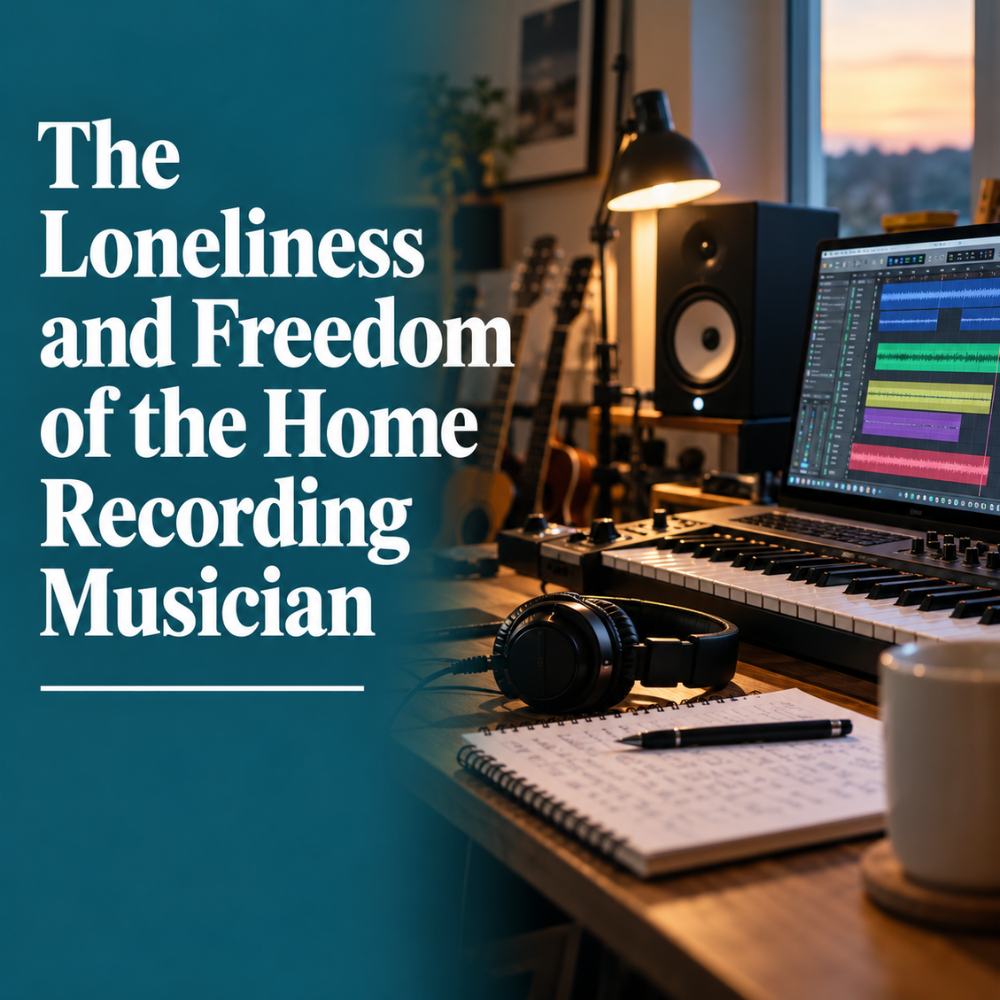
There is something slightly contradictory about home recording because it gives you enormous freedom while also being a very solitary way to make music. The home studio means I can work when I want, record what I want, take as long as I want and make as many mistakes as I need to without anyone watching. I can try an idea, abandon it, come back to it three days later, change the key, rewrite a verse, replace a guitar part or decide that the keyboard sound I loved yesterday now sounds ridiculous.
Nobody complains, and that freedom is one of the great advantages of making music at home. There is no clock running in the background, no studio bill increasing every hour and no pressure to get a part right because somebody else is waiting. I can stop for tea, walk away, come back, start again, or decide that the whole thing needs rethinking.
For an independent musician, that freedom is extraordinary because it allows ideas to develop slowly. A song does not have to arrive fully formed. It can grow. I can record a rough version, listen back, add another part, take something away, try a harmony, change the rhythm and gradually find out what the song wants to be.
That process suits me, but there is another side to it. When you record alone, there is nobody else in the room to tell you whether the idea is working. That can be liberating because you are not being judged, but it can also be dangerous because you are not being challenged.
In a band, ideas bounce around. Someone says the chorus needs lifting, someone else thinks the guitar part is too busy, and somebody suggests a different rhythm. There may be arguments, of course, but those arguments can be useful because they force decisions and bring other perspectives into the room. At home, you can spend a long time agreeing with yourself, and that is not always healthy.
One of the strangest parts of home recording is that you become creator and critic at the same time. You write the song, record the part, listen back and then decide whether what you have just done is any good. You are trying to be emotionally involved and detached at the same moment, which is difficult.
When you are too close to a song, judgement becomes unreliable. You know what you meant to do, how hard a part was to record, which line matters to you and the history of every decision. The listener knows none of that. They simply hear the result.
This is where the loneliness of home recording becomes more obvious. The song can live with you for weeks, sometimes months. You hear it repeatedly, become familiar with every detail and start to feel as though it belongs to a private world that only you fully understand. That closeness can make the song better because you have time to shape it carefully, but it can also make you lose perspective.
You stop hearing the whole track and start hearing the problems. The vocal sounds wrong, the guitar might be too loud, the keyboard part may be unnecessary, the bass could be tighter and the harmony may be doing too much. Eventually, you can reach the point where you have listened so often that you no longer know whether the song is improving or simply changing.
That is one of the reasons another pair of ears matters so much. For me, the home recording stage is where I build the song. I write it, arrange it and record the parts in Cubase, working on the instruments, vocals and overall structure until I feel I have taken the track as far as I can usefully take it.
Then I send the raw stems to Jermaine Nelson-Williams, and that moment is important because it breaks the isolation. Jermaine has not been sitting in the room while the song was being built. He has not lived with every decision, heard the thirty previous versions or spent an evening trying to make one small section behave.
He gets the song with fresh ears, and that distance is valuable. It means he can hear what I no longer can: the balance, the space, the clashes, the textures and the overall shape. He can make decisions based on what the track needs rather than what I remember putting into it.
For someone recording alone, that is a huge advantage because it also reminds me that independence does not have to mean isolation. There is sometimes an assumption that being an independent musician means doing everything yourself: write the song, play the instruments, record the parts, mix the track, master it, make the artwork, upload it, promote it and somehow remain enthusiastic throughout.
I do not think that is necessary. Independence can also mean choosing where collaboration adds value. For me, the home studio gives me creative control, while working with Jermaine gives me perspective and expertise. The two things fit together.
Still, there are long stretches when home recording is a solitary business. You can spend hours working on something nobody else has heard. You can make progress that feels enormous to you and is completely invisible to everyone else. You can solve a technical problem, improve a performance or finally make an arrangement work, then look around and realise there is nobody there to share the moment.
That can feel lonely, but it can also feel peaceful. There is a particular satisfaction in working quietly and privately, with no audience, no pressure and no need to explain what you are doing. Just the song, the computer, the instruments and the slow process of trying to make something work.
For many amateur musicians, that is part of the attraction. We are not necessarily building careers; we are building songs. There is something valuable in having a space where the work can happen without judgement, where bad ideas are allowed, mistakes are private and experiments can fail quietly.
Not every musical thought needs an audience straight away. Some need time, and home recording provides that. But eventually, the song has to leave the room.
That is where recording at home becomes something bigger. The private work becomes public. The track is mixed, mastered and released. It appears on streaming platforms. It may become a CD or vinyl record. It may be performed live. The solitude gives way to connection, and that transition is one of the most satisfying parts of the process.
Something that began alone becomes something that can be shared.
I think that is why the loneliness of home recording is not necessarily a negative thing. It is part of the creative space. The danger only comes when isolation becomes the whole process and no other ears are allowed in.
For me, the best balance is freedom first, perspective later. I want the space to build the song on my own terms, but I also want the point where someone else listens without carrying all the baggage that I do. That keeps the music moving.
The home studio gives me independence. It lets me work slowly, experiment, make mistakes and build songs in a way that suits me. It can be lonely, but it is also where the songs get made, and for me that freedom is worth a great deal.