
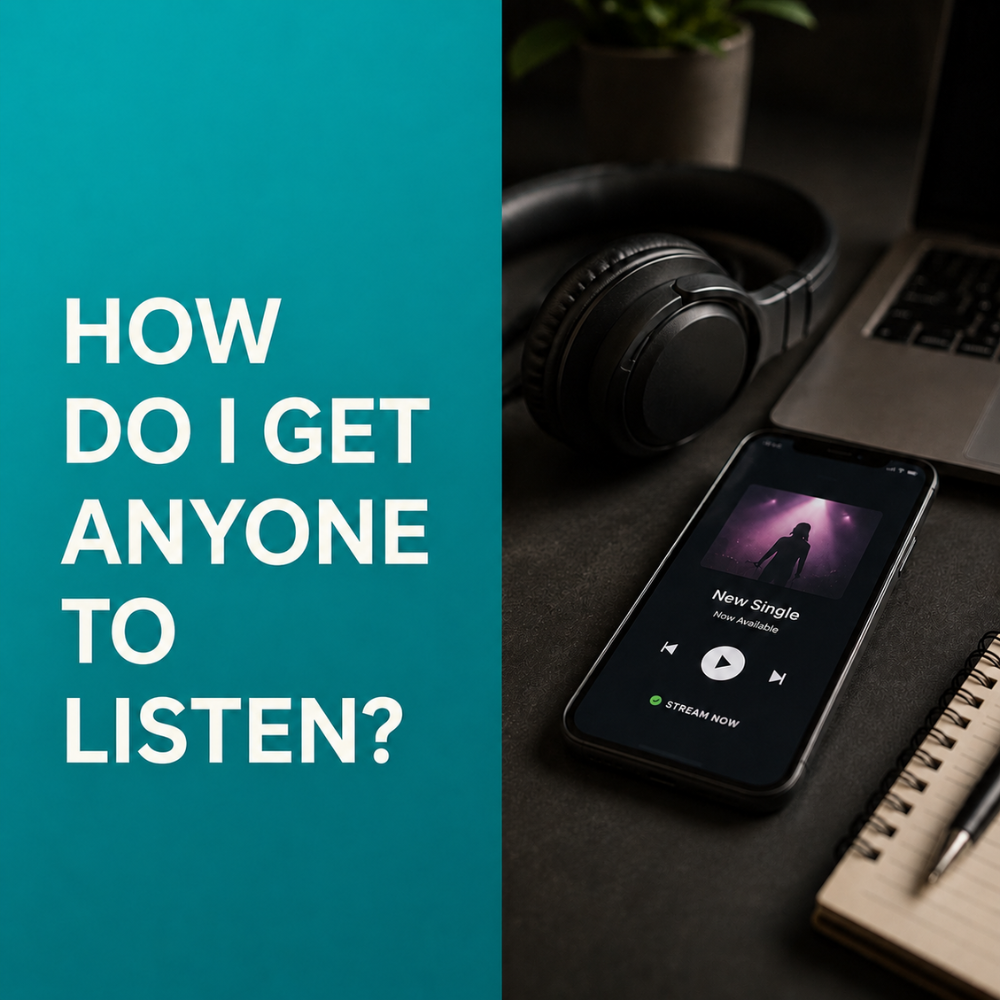
There is a strange moment that comes after you finish a song.
You have written it, recorded it, built the arrangement, listened to it far too many times, questioned every decision, sent the stems away, had it mixed, produced and mastered, checked the final version, uploaded it, added the artwork, written the description, chosen the release date and pressed whatever button now passes for “put this into the world”.
And then…
Nothing much happens.
This is not always the case, of course. Sometimes people respond. Sometimes they comment, share, like, message, listen, or say something kind. Those moments are lovely, and they matter. But for most amateur and independent musicians, releasing music is not a thunderclap. It is more like opening a small window in a very large building and hoping somebody walking past happens to look up.
That is the reality of making music now.
The great blessing of modern technology is that anyone can release music. The great curse of modern technology is that anyone can release music. This means your song can sit on Spotify, Apple Music, Amazon and the other usual platforms, available to listeners around the world. It also means your song is entering a space already full of other songs, other artists, other releases, other campaigns, other playlists, other videos, other distractions and other people saying, with equal sincerity, “Please listen to this.”
So the question becomes unavoidable.
How do I get anyone to listen?
For amateur musicians, this can be harder than the recording itself. Recording is difficult, but at least it feels like music. Promotion feels different. It can feel awkward, repetitive and faintly embarrassing. You are no longer simply making something; you are asking people to pay attention to something you made.
That is not easy.
Most musicians are not natural salespeople. We may be happy enough spending hours choosing a guitar sound, rewriting a line or arguing silently with Cubase, but repeatedly telling people about our own music can feel uncomfortable. There is always the fear of becoming annoying. You do not want every social media post to sound like a man standing in the middle of the street shouting, “I have released a song and I am prepared to keep mentioning it until morale improves.”
And yet, if you do not mention it, how will anyone know?
That is the difficult bargain of releasing music today. The platforms make songs available, but availability is not the same as attention. Uploading a track does not mean people will find it. Putting music on streaming services is like placing a book in the world’s largest library without a sign, a shelf number or a librarian who knows your name.
It exists.
That is not the same as being discovered.
This is why social media has become such an important part of the modern musician’s life. Facebook, Instagram, X, Bluesky, LinkedIn, YouTube, websites, mailing lists — they all become part of the same problem. How do you tell people about your music in a way that feels human rather than desperate?
I am still learning that.
I have my own website, which helps. It gives me somewhere permanent to put articles, stories, music links, news and reflections. Social media posts disappear quickly. A website gives the work somewhere to live. It also means I can do more than simply post, “Listen to my song.” I can explain the thinking behind the music, talk about the recording process, write about being an amateur musician, share stories, and hopefully give people a reason to connect before asking them to listen.
That feels more natural to me.
It also reflects the truth that people often connect with the story before they connect with the song. Not always, but often. A song may be the centre of it, but the journey around the song can matter too. Why was it written? How was it recorded? What did it take to finish it? What does it mean to still be making music when nobody is exactly waiting for your next release with a candlelit vigil?
These are the things other musicians understand.
There is comfort in realising that the problem is not just yours. Almost every independent artist faces the same challenge. The tools are there. The distribution is there. The platforms are there. But attention is scarce. People are busy. Algorithms are mysterious. Posts vanish. Streams trickle. You can put real effort into something and still feel as if you are whispering into a storm.
That can be discouraging.
But it can also be freeing, in a strange way. Once you accept that there is no simple magic button, you stop looking for one. There is no single post, playlist, hashtag, platform or clever trick that suddenly makes everything happen. What remains is quieter and less glamorous: consistency, patience, honesty and the willingness to keep showing up.
That does not mean shouting louder.
It means finding ways to keep the music visible without losing yourself in the process. It means sharing the songs, but also sharing the story. It means accepting that some posts will be ignored, some links will not be clicked, and some people will mean to listen later in the same way we all mean to sort out the drawer full of cables.
But some people will listen.
That is worth remembering.
It is easy to become obsessed with numbers. Streams, likes, shares, reach, followers, saves — they all appear to measure something, and perhaps they do. But they do not measure everything. They do not measure the person who listened quietly and enjoyed it without saying so. They do not measure the friend who played the CD in the car. They do not measure the one comment that keeps you going for another week.
For an amateur musician, those small connections matter.
Of course, I would like more people to listen. Any musician who says otherwise is either unusually noble or lying in a very attractive way. We make songs because we want them to be heard. That does not mean we expect fame. It simply means the song feels incomplete if it never reaches anyone else.
A song starts privately, but it is not meant to stay there forever.
The challenge is learning how to invite people in. Not bully them. Not guilt them. Not bombard them. Invite them. That is a different thing. It means saying, “Here is something I made. Here is why it matters to me. You may find something in it too.”
That feels like a better way to promote music.
It may also be more sustainable. Constant self-promotion can become exhausting. It can turn the thing you love into a task list. Write the post. Share the link. Check the stats. Worry about the stats. Try another post. Wonder whether the image is right. Wonder whether the wording is right. Wonder whether anyone alive has ever clicked a link from social media without being tricked by a cat video.
At some point, you have to protect the music from the marketing.
That is why I think a website matters. It is slower, steadier and more personal. It allows the songs to sit within a bigger story. It lets me write about the amateur musician’s life, the home studio, the recording process, streaming, physical albums, persistence and all the odd little realities that surround making music today.
Then social media becomes a signpost rather than the whole building.
That suits me better.
So how do I get anyone to listen?
There is no perfect answer. I think you keep making the music as well as you can. You release it properly. You make it easy to find. You talk about it honestly. You build a home for it on your website. You share the links without apology, but without turning into a human advert. You accept that attention is difficult to earn and impossible to demand.
And then you keep going.
Because the truth is that getting heard has always been hard. The methods have changed, but the longing is the same. Every songwriter wants someone, somewhere, to press play and feel that the song was worth their time.
That is not a small thing.
In the end, perhaps the best we can do is keep opening the window.
Somebody might look up.
You can listen to my music on Spotify, Apple Music, Amazon and the usual streaming platforms, or explore more of my songs, albums and stories here on my website.