
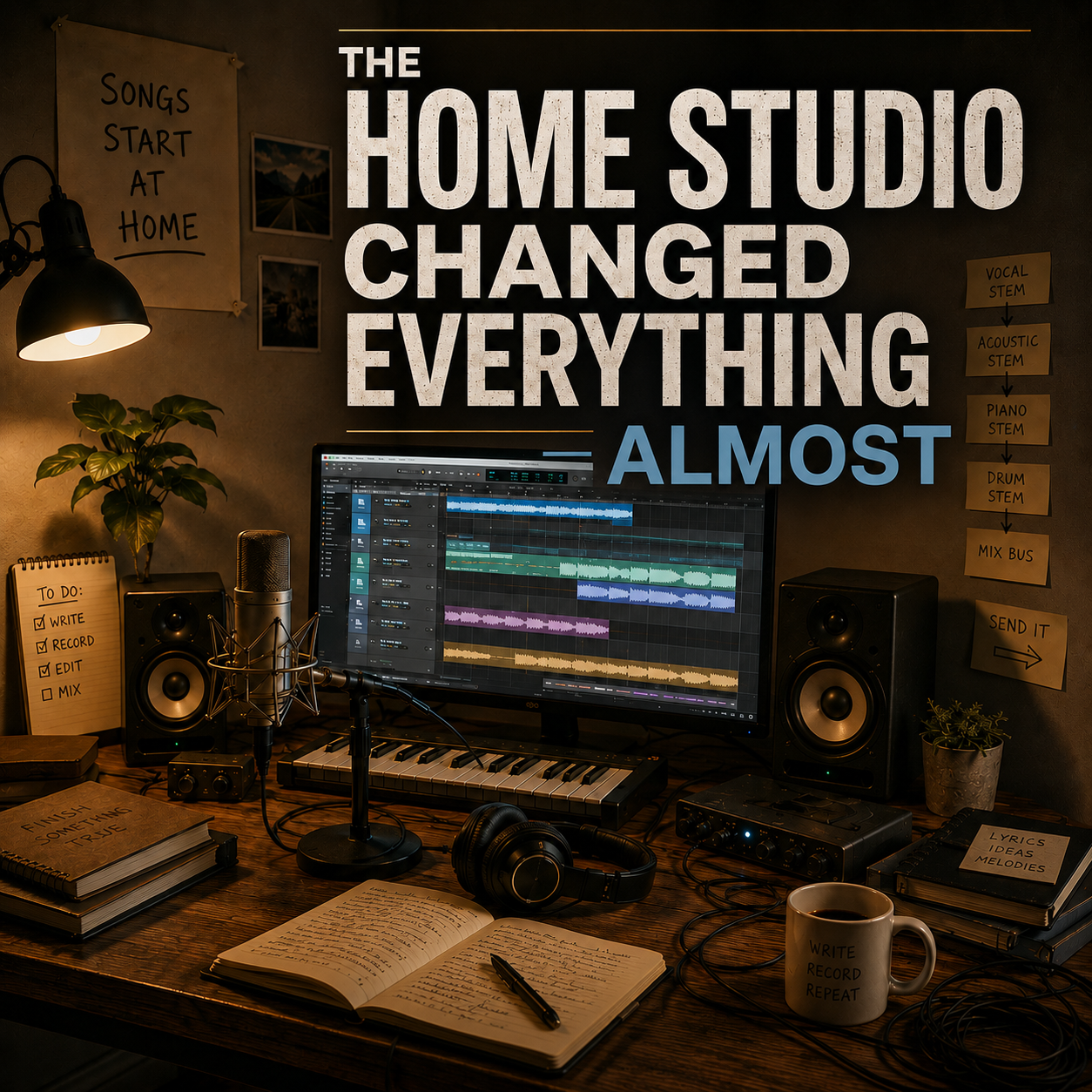
There was a time when the phrase “home studio” sounded far grander than the reality.
In my case, it meant a room in the house, a computer, Cubase, a microphone, a keyboard, a pair of headphones, some speakers and enough cables to make the back of the desk look like an unsolved crime scene. Oh, and my guitar….
I’ve written before, in my My Story section, about my first serious step into the world of digital recording. I went to Dawsons Music in Warrington, asked questions I barely understood, came home with a car boot full of boxes and began the long, bewildering process of trying to make sense of it all.
The software was Cubase, and I still use Cubase now.
That feels worth saying, because in a world where technology changes at ridiculous speed, there is something oddly comforting about the fact that the basic idea has remained the same. I still sit down with a song. I still try to capture what I can hear in my head. I still spend too long nudging things around, listening back, wondering whether the guitar is too loud, the vocal is too quiet, the harmony is necessary, the bass is doing anything useful, or whether the whole thing should be quietly deleted and never spoken of again.
So, in that sense, nothing has changed.
In every other sense, almost everything has.
When I first started using Cubase, it felt like entering a foreign country without a phrasebook. I had come from the world of writing songs on a guitar, where the rules are fairly simple. You play a chord, you sing a line, and you either like it or you don’t. Recording on a computer was a different beast altogether. Suddenly there were tracks, buses, plugins, MIDI, latency, sample rates, interfaces, virtual instruments, tempo maps and menus that seemed to contain other menus that led only to further confusion.
I didn’t so much learn Cubase as gradually stop being frightened of it.
Bit by bit, though, the fog lifted. I learned enough to record my songs properly, or at least properly enough to get the ideas out of my head and into the world. That, for me, was the big change. The home studio did not turn me into George Martin, Brian Eno or Quincy Jones. It did something much more important. It gave me a way to preserve songs that might otherwise have disappeared.
That is still the miracle of home recording.
For amateur musicians, technology has been a gift. A huge gift. It means you no longer need to book expensive studio time simply to find out whether a song works. You can try things. You can build an arrangement slowly. You can put down a rough vocal, add a guitar, try a keyboard part, take the keyboard part off again, add a harmony, decide the harmony makes you sound like a small choir trapped in a cupboard, remove it and carry on.
You can make mistakes privately, which is one of the great underrated luxuries of modern music-making.
In the old days, the studio clock was always ticking. Even if I was never exactly operating at Abbey Road level, the idea of paying for time in a professional studio made every mistake feel expensive. At home, the only person charging me by the hour is myself, and I have so far been remarkably lenient.
But technology also creates its own problems. The home studio gives you almost unlimited choice, and unlimited choice is not always your friend. There are endless sounds, endless plugins, endless ways of polishing, improving, correcting, repairing and generally interfering with a song until you can no longer remember why you liked it in the first place.
A song that starts with a simple idea can quickly become a hostage situation.
That is where I have had to learn some discipline. My job in my home studio is not to create a finished masterpiece all on my own. My job is to get the song into the best possible shape I can. I record the parts, build the arrangement, sing the vocals, add the instruments and try to make sure the song says what I want it to say.
Then I send the finished stems to my producer, Jermaine Nelson-Williams, and let him work his magic.
That relationship is important. It means the music still begins at home, with me, but it does not have to end there. I can record the song in a way that is personal and honest, then hand it over to someone with the ears, skill and production judgement to make it sound far better than it would if I simply sat there clicking buttons until midnight and hoping for the best.
There is a great freedom in that.
It also reflects one of the best things about being an amateur musician today. You can do an extraordinary amount yourself without having to do absolutely everything yourself. You can write at home, record at home, collaborate remotely, send files across the internet and work with people who bring different skills to the music. That would have seemed astonishing when I first started trying to understand Cubase with a manual the size of a paving slab.
Of course, the downside is that because everything is possible, you can start to feel that everything is also your responsibility. You are the songwriter, singer, guitarist, arranger, editor, demo producer, administrator, social media department and occasional IT support technician. Some days you feel like a musician. Other days you feel like a man arguing with an audio driver.
And yet I would not go back.
For all the frustrations, home recording changed everything for me. It allowed me to hear my songs properly. Not just as guitar-and-voice sketches, but as arrangements. It allowed me to layer parts, experiment, fail, improve and keep going. It made the private world of songwriting audible.
That still amazes me.
The technology has moved on dramatically since I first brought that equipment home from Dawsons. Cubase is more powerful. Computers are faster. Sounds are better. Help is everywhere. If I get stuck now, there is usually a tutorial, a forum post or a video of someone calmly explaining the very thing that has made me question all my life choices.
But the heart of it has not changed.
A song still starts as a small, fragile thing. A few chords. A line. A feeling. A memory. A phrase that will not leave you alone. The home studio does not write the song for you. It does not decide whether the lyric is honest or whether the chorus lifts. It does not know if the vocal means anything.
That part is still down to the person in the room.
So yes, the home studio changed everything.
Almost.
It changed how I record, how much I can do, how far I can take an idea and how easily I can share music with others. But it did not change the reason for doing it. I still sit there because I have songs I want to finish. I still open Cubase because some part of me believes the next one might be worth the effort.
And, thankfully, I no longer need to print out several hundred pages of manual to get started.
You can listen to my music on Spotify, Apple Music, Amazon and the usual streaming services, or explore more of my songs and albums here on my website.